Building Abstractions with Classes
Part 1 ended with invariants maintained by hand. In Chapter 4, we wrote a constructor function that established an invariant when a value was created, and hid the value's state inside a closure so that only a fixed set of operations could change it.
This chapter introduces object-oriented programming, which provides the same pattern as language syntax. The mechanism is the class, a named unit that bundles state with the operations that maintain it.
A Playlist with a Current Song
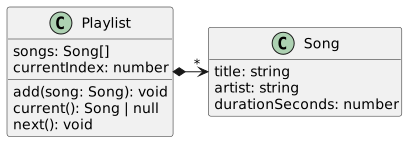
Consider the running example for this chapter:
As a listener, I want a playlist that always knows which song is current, so that pressing "next" moves through my music predictably as I add and remove songs.
A playlist holds a list of songs and remembers which one is current, so that an interface can show what is playing and advance to the next song. The current position is an index into the list of songs. Its type is number, but not every number is meaningful. Only an index that points at a real song makes sense, and when the playlist is empty there is no current song at all. This rule, that the current index is always a valid position in the list (or a sentinel when the list is empty), is an invariant. As in Part 1, the type system cannot express it, because number permits -4 and 9999 as readily as a valid index.
Keeping State Consistent
An invariant like "the current position points to a real song in the playlist" is only useful if it is always true. In a small program it can be maintained through discipline, where every place that changes the song list also fixes the current index.
That discipline does not scale. Suppose the song list and the index are global variables, which any part of the system can read and write. Then any part of the program can leave the index pointing at a song that no longer exists, and splitting the program into more files does not help, because every file can still reach the variables. To maintain the invariant, we would have to audit the whole program, which is costly and error-prone.
What we want is a way to bundle the state (the songs and the index) with the operations that are allowed to change it (add, remove, advance). The invariant then becomes the responsibility of one small, named unit, a class, rather than of every caller.
From Closures to Classes
The closure pattern from Chapter 4 bundled state with operations using only what you knew from CPSC 110, but without support from the language. Here is a playlist built with closures, as a constructor function whose returned operations close over the hidden state:
type Playlist = {
    add(song: Song): void;
    current(): Song | null;
    next(): void;
};

function makePlaylist(): Playlist {
    const songs: Song[] = [];   // hidden state
    let currentIndex = -1;      // hidden state; -1 means empty

    return {
        add(song: Song): void {
            songs.push(song);
            if (currentIndex === -1) {
                currentIndex = 0;
            }
        },
        current(): Song | null {
            return currentIndex === -1 ? null : songs[currentIndex];
        },
        next(): void {
            if (currentIndex !== -1) {
                currentIndex = (currentIndex + 1) % songs.length;
            }
        }
    };
}The state (songs and currentIndex) is reachable only through the three returned operations, so the invariant is safe. But the language gives no help: the connection between the state, the constructor function, and the operations exists only because we arranged it by hand.
A class expresses the same arrangement with support from the language. The same playlist, written as a class, looks like this:
class Playlist {
    songs: Song[] = [];
    currentIndex: number = -1;

    add(song: Song): void {
        this.songs.push(song);
        if (this.currentIndex === -1) {
            this.currentIndex = 0;
        }
    }

    current(): Song | null {
        return this.currentIndex === -1 ? null : this.songs[this.currentIndex];
    }

    next(): void {
        if (this.currentIndex !== -1) {
            this.currentIndex = (this.currentIndex + 1) % this.songs.length;
        }
    }
}Each piece of the closure maps onto a piece of the class:
| Closure version | Class version |
|---|---|
Variables closed over (songs, currentIndex) | Fields |
The makePlaylist function | The constructor |
| The returned operations | Methods |
| Reaching state by closure | Reaching state through this |
The behaviour is identical. The class adds what the hand-built version lacked: one declaration that holds the state, the constructor, and the operations together, and a standard way to construct instances with new. In one respect the class is weaker. The closure's variables were unreachable from outside, but these fields can be read and written by any code that holds a Playlist. Chapter 12 fixes this, and the rest of this chapter develops the class itself.
Classes and Constructors
A class is the primary unit of abstraction in object-oriented programs. It can be read as a template for a kind of value, describing the state every value of that kind holds and the operations every such value provides. Most object-oriented languages, including C++, Java, Python, and TypeScript, provide classes.
Where classes are stored
Classes are stored in files. In some languages, like Java, a file contains one public class. TypeScript has no such restriction, and a file can contain several classes. In practice, it is most predictable for a file to contain one class and for the filename to match the class name.
As systems grow, these files are organised into folders with meaningful names that group related classes together.
Each class declares a type named for the class. As with type in Part 1, the name should be chosen carefully, because it is the shortest description of what the class is for.
Class Declarations
The class declaration
class X {
   // ...
}
is a statement that declares the name X as a type.
A class on its own describes its values but does no work. To use a class, we create an instance with the new operator:
const favourites: Playlist = new Playlist();The new operator
The statement
new T();creates an object of class T. new T() calls the constructor declared by class T, and evaluates to the new instance of T.
new calls a special method on the class, its constructor, which runs before the object can be used. In TypeScript, the constructor is named constructor:
class Playlist {
    constructor() {
        // configure class here
    }
}
The constructor is the single point where every object of the class comes into existence, which makes it the place to establish invariants, as the constructor function did in Chapter 4. Once the constructor has established an invariant, every method can assume it holds, and each method must preserve it, as in Part 1.
Constructors
Within a class, the constructor() statement:
class T {
   constructor() {
     // empty default constructor
   }
}
defines how objects of type T are created. We do not call constructor() directly. new T() calls it. Unlike other functions, a constructor has no return type annotation, because it always produces an instance of its class. If a class declares no constructor, TypeScript provides a default one that takes no arguments.
Creating an object from a class is called instantiating the class, and the object is an instance of it. Every instance is an object with its own state, independent of every other instance.
const favourites: Playlist = new Playlist();
const workout: Playlist = new Playlist();
Adding a song to favourites does nothing to workout. This independence is one way classes help manage state: a program can hold many objects, each responsible for its own part of the world.
A class combines state and functionality. We look at each in turn.
Class State
State is held in fields, named and typed properties that each object stores independently. The Playlist class has two, the list of songs and the current index:
class Playlist {
    songs: Song[] = [];
    currentIndex: number = -1;
    // ...
}
The = [] and = -1 give the fields default values, used when the constructor does not set them otherwise.
Fields and this
The following defines a field named myField of type X within class T.
class T {

    myField: X;

    constructor(theField: X) {
        this.myField = theField;
    }
}
The this keyword refers to the current instance of the class, and only makes sense inside a class body. In the constructor, this.myField refers to myField in the object being constructed.
Default Initialising Fields
When a field has a default initial value that the constructor does not need to customise, rather than writing:
class T {
   myField: X;
   constructor() {
      this.myField = <default value>;
   }
}
we can write:
class T {
    myField: X = <default value>;
}
This sets the default value of myField to <default value>, which can be any expression. Setting a default is equivalent to setting the field in the constructor.
Declaring a field is straightforward. Decide what state you need to track, give it a clear name and a type, and decide whether it has a default value or must be supplied through the constructor. The harder question is what should be state at all, as opposed to a local variable inside a method. As a rule of thumb, data belongs in a field if its value must survive after a method returns, or must be visible to other methods.
Class Functionality
Functionality is provided by methods. A method is a function property that acts on the object's state. Most methods preserve or observe the class's invariants.
Methods (and this again)
The following defines a method firstMethod for class T:
class T {
    firstMethod(x: X, y: Y): Z {
       // do something with x and y to return a value of type Z
    }
}
Given an instance const t: T = new T(), we call the method with t.firstMethod(...), and the call can see only the data stored in t. To call one method from another, use this:
class T {
    firstMethod(x: X, y: Y): Z {
       if (this.secondMethod()) {
         // ...
       }
    }

    secondMethod(): boolean {
       // ...
    }
}
A method has a name, takes zero or more parameters, and either returns a value or is declared void. Declaring a return type of void tells a reader that the lack of a return value is intentional.
Declaring a method involves a few decisions:
- What the method is for, and a name that captures that intent.
- What parameters it takes, with their names and types.
- What it returns, and its type.
It can help to think about testing. If you know what you want to check about a method, its parameters are the data you would pass it and its return value is the result you would inspect. Unlike a free function, though, a method can also read and change the object's fields, so part of its input and part of its result may live in the object rather than in its parameters and return value.
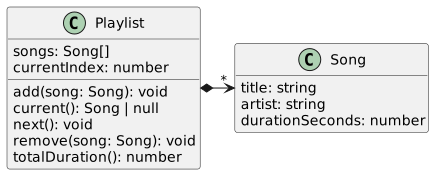
Here is the Playlist class with its methods, including the remove operation that makes the invariant interesting:
class Playlist {
    songs: Song[] = [];
    currentIndex: number = -1;

    /** Adds a song to the end; the first song added becomes current. */
    add(song: Song): void {
        this.songs.push(song);
        if (this.currentIndex === -1) {
            this.currentIndex = 0;
        }
    }

    /** Returns the current song, or null when the playlist is empty. */
    current(): Song | null {
        return this.currentIndex === -1 ? null : this.songs[this.currentIndex];
    }

    /** Advances to the next song, wrapping back to the start. */
    next(): void {
        if (this.currentIndex !== -1) {
            this.currentIndex = (this.currentIndex + 1) % this.songs.length;
        }
    }

    /** Removes the given song, keeping the current position valid. */
    remove(song: Song): void {
        const i: number = this.songs.indexOf(song);
        if (i === -1) {
            return;
        }
        this.songs.splice(i, 1);
        if (this.songs.length === 0) {
            this.currentIndex = -1;
        } else if (i < this.currentIndex) {
            this.currentIndex = this.currentIndex - 1;
        } else if (this.currentIndex >= this.songs.length) {
            this.currentIndex = this.songs.length - 1;
        }
    }

    /** Total playing time of the playlist, in seconds. */
    totalDuration(): number {
        return this.songs.reduce((sum, song) => sum + song.durationSeconds, 0);
    }
}Removing a song can invalidate the current index. If the removed song was before the current one, every later index shifts down by one, and if the removed song was the last one and it was current, the index now points past the end. Each branch repairs the index so that the invariant still holds when remove returns. The caller does not have to think about any of this, because the work of keeping the index valid lives with the data it constrains, inside the method, rather than in the calling code.
In remove, indexOf finds the song by identity, so remove removes the exact object it was given and ignores a separately built song with identical fields. Whether that is reasonable to expect of a caller is a design question that Chapter 13 takes up.
Programming Paradigms
The class is a third way of organising a program, alongside two paradigms from Part 1.
Functional programming builds values and transforms them with functions, without mutation. We saw this in Part 1 when we modelled data as types and processed it with pure functions. Summing the durations of a list of songs functionally looks like this, with no mutation:
const total: number = songs.reduce((sum: number, song: Song) => sum + song.durationSeconds, 0);Imperative programming is a sequence of statements (Chapter 1) that read and change state (Chapter 6) step by step. Recursion is the idiomatic functional way of handling variable-sized data, and loops (Chapter 5) are the idiomatic imperative way. Imperatively, the same sum looks like this:
let total: number = 0;
for (const song of songs) {
    total = total + song.durationSeconds;
}
Object-oriented programming bundles state with the operations that maintain it. Written this way, the sum is a question we ask an object:
const total: number = playlist.totalDuration();The three styles are often mixed: a method body is usually imperative, a class can hold immutable values, and a functional pipeline can run inside a method. They differ in how a program is organised, and object-oriented programs are organised around objects that own their state.
Classes Are Types
Declaring a class declares a type, and that type behaves like any other type from Part 1. Playlist can annotate a variable, type a parameter, be a return type, or be the element type of an array:
function longest(playlists: Playlist[]): Playlist | null {
    let longestSoFar: Playlist | null = null;
    for (const playlist of playlists) {
        if (longestSoFar === null || playlist.totalDuration() > longestSoFar.totalDuration()) {
            longestSoFar = playlist;
        }
    }
    return longestSoFar;
}
The compiler checks these annotations as it did for the types in Part 1. A function that expects a Playlist cannot be given a Song, and the result of longest is known to be a Playlist or null, so a caller must handle the empty case.
Objects and References
A field of one object can hold another object, and a variable that "holds" an object actually holds a reference to it, as in Chapter 6. This has two consequences:
- Two objects are distinct even when their contents match. Each
newproduces a separate object with its own identity:
const a: Playlist = new Playlist();
const b: Playlist = new Playlist();
// a === b is false: they are different objects- When an object is passed to a function or stored in a field, the reference is copied, not the object. The caller and the callee then share one object, so a change made through either is visible to both. This is the aliasing from Chapter 6, and as that chapter showed, primitives behave differently.
Working with Objects
A class declaration only describes what its objects look like. To do work, we instantiate objects and call their methods with dot notation: in playlist.next(), the . separates the object from the method called on it. Because every object holds its own fields, a method call on one object does not affect another.
The following program uses two independent playlists:
const favourites: Playlist = new Playlist();
const workout: Playlist = new Playlist();

const a: Song = { title: "Aubade", artist: "Dawn Quartet", durationSeconds: 180 };
const b: Song = { title: "Bassline", artist: "Low End", durationSeconds: 240 };
const c: Song = { title: "Cadence", artist: "The Meter", durationSeconds: 200 };

favourites.add(a);
favourites.add(b);
favourites.add(c);
expect(favourites.current()).to.deep.equal(a);   // first song added is current

favourites.next();
expect(favourites.current()).to.deep.equal(b);

favourites.remove(b);                            // removing the current song keeps the index valid
expect(favourites.current()).to.deep.equal(c);   // c shifted into b's old position

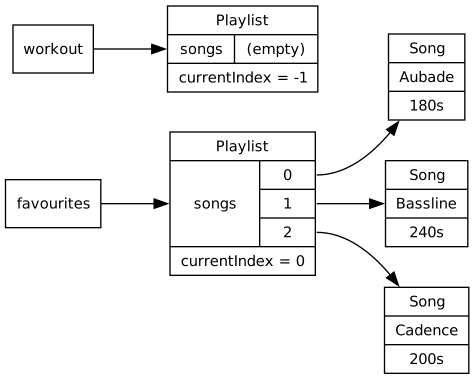
expect(workout.current()).to.equal(null); // workout is untouched and still emptyAfter the three add calls, the objects and the references between them look like this. Each variable holds a reference to its own Playlist, and the cells of favourites' songs hold references to three separate Song objects. currentIndex, by contrast, is an ordinary number, not a reference:
Testing Classes
In Chapter 9, we tested pure functions by passing them arguments and inspecting the return value.
Testing a class is different, because an object carries state between calls. A test usually constructs an object, performs a sequence of operations, and then checks the resulting state: the object's observable behaviour, not a single return value. This test adds two songs to a Playlist, moves to the second, and removes it:
const songA: Song = { title: "Aubade", artist: "Dawn Quartet", durationSeconds: 180 };
const songB: Song = { title: "Bassline", artist: "Low End", durationSeconds: 240 };

test("removing the current song keeps the position valid", () => {
    const playlist: Playlist = new Playlist();
    playlist.add(songA);
    playlist.add(songB);
    playlist.next();                                  // current is now songB
    playlist.remove(songB);                           // remove the current song
    expect(playlist.current()).to.deep.equal(songA);  // the position stayed valid
});
The test-design ideas from Part 1 still apply. Equivalence classes and boundaries now describe sequences of method calls rather than single arguments: an empty playlist, a one-song playlist, and removing the current song versus another song. Layered assertions apply to whatever state the object exposes.
Almost every test of a class starts by building a fresh object. Writing new Playlist() at the top of every test is repetitive, but sharing one object across tests is worse, because one test's changes would leak into the next. A beforeEach hook inside a describe block, as in Chapter 9, is the natural place to create a fresh object:
describe("Playlist", () => {
    let playlist: Playlist;

    beforeEach(() => {
        playlist = new Playlist();   // a fresh, empty playlist before each test
    });

    test("a new playlist has no current song", () => {
        expect(playlist.current()).to.equal(null);
    });

    test("the first song added becomes current", () => {
        playlist.add(songA);
        expect(playlist.current()).to.deep.equal(songA);
    });
});
Each test now gets its own playlist, unaffected by any other, so the tests are independent and can run in any order.
The Value of Class Abstractions
A class is a unit of abstraction because it bundles state with the operations that maintain it. A client reasons about what a Playlist does, through its methods, without needing to know how it keeps the current index valid. Because those methods live alongside the state they protect, a client that uses only the methods cannot leave a Playlist in an inconsistent state, and the rest of the program no longer has to keep that state consistent.
To use a class, a client only needs to find one that models what they care about and call its methods. Naming therefore matters in class design, because a good name lets an engineer find the abstraction they need without reading the code that implements it.
Exercise: Designing a Class
Design a class for the scenario below, following the same path this chapter used for Playlist.
As a homeowner, I want a thermostat whose target temperature I can nudge up or down but never set outside a safe range, so that the house is never driven dangerously hot or cold.
For this task, design a class, name it, and determine its invariants. Decide what fields it should hold, and design the methods that update that state. There are many possible designs for a problem like this, so try to come up with more than one and compare their strengths and weaknesses.