Maintaining Invariants
The previous chapter described invariants in documentation and tests. Tests can detect problems: they probe chosen inputs and report when a function's outcome is not the one its contract promised. But tests cannot prevent invalid values from being created. This chapter is about designing code so that invalid values cannot be created, rather than checking for them afterwards.
We will do this using only programming constructs you know from CPSC 110. The result is not standard TypeScript, and you may find it unwieldy. That is part of the point: it motivates the object-oriented programming in Part 2.
A Bank Account with No Enforcement
We start from a simple BankAccount design, with a data type that has an invariant and some functions:
/**
 * A bank account with a balance in dollars.
 *
 * Invariant: balance >= 0
 */
type BankAccount = {
  balance: number;
};

/**
 * Deposits an amount into the account.
 *
 * Precondition: amount > 0
 * Postcondition: the returned account satisfies balance >= 0
 *
 * @param {BankAccount} account the account to deposit into
 * @param {number} amount the amount to deposit (in dollars)
 * @returns {BankAccount} a new BankAccount with an increased balance
 */
function deposit(account: BankAccount, amount: number): BankAccount {
  return { balance: account.balance + amount };
}
The withdraw function looks similar. Once the contracts are documented, tests can be derived from them.
Valid Types, Invalid Values
The type checker will not complain about invalid values:
const account: BankAccount = { balance: -100 }; // passes the type checkerThis is the same issue we encountered with the Song whose duration was -30: the object has the right shape, so the static check passes, but its meaning is incorrect.
Nothing about the BankAccount type connects it to deposit and withdraw. We can build any object literal with a balance property and call it a BankAccount, whether the invariant remains true or not.
For an invariant to hold for the life of a program, two things must be true:
- When the value is created, the invariant must be established; and
- Every operation that produces a new value from an old one must preserve the invariant.
If both are true, then every value that ever exists is valid: the first one was checked, and every subsequent value came from an operation that maintained the invariant. In the initial design, anyone could create an account by writing an object literal, so nothing ensures the invariant is established.
Constructor Functions
To ensure the invariant is established, we write a function whose only job is to create valid accounts:
/**
 * Creates a new bank account holding balance dollars.
 *
 * @param {number} balance the starting balance
 * @returns {Result<BankAccount, string>} ok: true with a new account
 * satisfying the invariant, or ok: false with "Account balance must not
 * be negative" when balance < 0
 */
function makeAccount(balance: number): Result<BankAccount, string> {
  if (balance < 0) {
    return { ok: false, error: "Account balance must not be negative" };
  }
  return { ok: true, value: { balance: balance } };
}
A function like this is called a constructor function: it constructs values of a type, and it ensures the invariant is established. Here a negative starting balance is an erroneous outcome. The request is refused, and no account is built. Every account the constructor does return is valid:
test("accounts cannot be created with a negative balance",
    checkExpect(() => makeAccount(-100), {
        ok: false,
        error: "Account balance must not be negative"
    })
);
Accounts created with makeAccount satisfy the invariant. Unfortunately, the protection is only a convention. Nothing forces a client to call makeAccount: the literal { balance: -100 } still type checks. The same is true of deposit and withdraw, since a client can skip them and write { balance: account.balance - 200 }. The constructor function and the operations exist alongside data that remains open to everyone.
The invariant is safe only if every engineer chooses to go through the right functions. This is the kind of programmer discipline we have been trying to avoid relying on.
Binding Operations to Data
The main problem is that the data is reachable by anyone, so the operations can be bypassed. To solve it, the data must be reachable only through operations that maintain the invariant. To do this, we need a feature we have not yet used in TypeScript: an object property that holds a function. We can define a BankAccount type whose properties are operations rather than data:
/**
 * A bank account that accepts deposits and withdrawals.
 *
 * Invariant: balance >= 0
 */
type BankAccount = {
  deposit(amount: number): Result<BankAccount, string>;
  withdraw(amount: number): Result<BankAccount, string>;
  getBalance(): number;
};
There is no balance field. The BankAccount type now describes what an account can do rather than what it stores. A holder of a BankAccount can deposit, withdraw, and observe the balance (getBalance), and that is all. Each of these operations can be invoked with dot notation:
// given an initialAccount of type BankAccount ...
const deposited = initialAccount.deposit(5); // a Result<BankAccount, string>
We have seen dot before. In Chapter 2 it read a property: song1.title selected the value stored under title. initialAccount.deposit selects the value stored under deposit in the same way. The only difference is that the value there is a function rather than a string or a number. The (5) that follows is an argument, just as in letterGrade(85).
What matters is which function you get. A free-standing deposit(account, 5) is one function shared by every caller, which is why it has to be told which account to act on. initialAccount.deposit is the function belonging to this specific account, so it operates on that account's balance. A caller cannot point it at a different account.
Functions as Properties
So far, every object property we have used has held a data value: song.title held a string, and account.balance held a number.
A property can also hold a function. In particular:
type T = {
  foo(x: X, y: Y): Z;
};
declares a function property foo on the type T. foo takes two parameters, x and y, of types X and Y, and returns a value of type Z.
In an object literal, the property is written like a function declaration without the function keyword:
{
  foo(x: X, y: Y): Z {
    // statements that compute and return a Z
  }
};
If t is of type T, we can call the function property foo with dot notation: t.foo(an_x, a_y).
We will revisit what it means for behaviour to belong to data like this when we introduce object-oriented programming in Part 2.
Operations in Structures in ISL
CPSC 110 allowed a similar approach. A structure's fields could hold functions, so a data definition could bundle a value's operations with the value itself.
(define-struct counter-interface (increment get-count))
;; Counter is (make-counter-interface (-> Counter) (-> Number))
;; interp. a counter that carries its own operations
Removing the balance field solves the preservation problem: nobody outside can reach balance. But it introduces a new problem. The operations themselves can no longer access a balance field either, which they need to do their job. We need a balance that only the operations can reach.
Hiding State with a Closure
The initial balance arrives as the constructor function's parameter, and we can keep it there using a concept you've seen in CPSC 110. A function created inside another function keeps access to the enclosing function's parameters and definitions, even after the enclosing function has returned. A function that carries context like this is called a closure.
A Clicker Counter
To (re-)introduce closures, we'll consider a problem simpler than the bank account:
As a door attendant at a venue, I want a clicker counter that refuses to count past the venue's capacity, so that we never admit more people than fire regulations allow.
You Built Closures Before
In CPSC 110, you saw closures, in particular using local. Functions defined in a local could use the parameters of the enclosing function, and a value's state could be kept unreachable by only providing access to the inner functions:
;; Venue capacity
(define MAX-CAPACITY 1000)

;; make-counter : Number -> Counter
;; Protects the invariant: count cannot exceed MAX-CAPACITY
(define (make-counter n)
  (cond [(> n MAX-CAPACITY) (error "Invariant violation: Venue is full!")]
        [else
          (local [;; increment : -> Counter
                  (define (increment)
                    (make-counter (+ n 1)))

                  ;; get-count : -> Number
                  (define (get-count)
                    n)]
           (make-counter-interface increment get-count))]))
The inner functions close over n.
Note the local is not strictly necessary. We could put lambdas directly in make-counter-interface and they would also close over n:
;; Venue capacity
(define MAX-CAPACITY 1000)

;; make-counter : Number -> Counter
;; Protects the invariant: count cannot exceed MAX-CAPACITY
(define (make-counter n)
  (cond [(> n MAX-CAPACITY) (error "Invariant violation: Venue is full!")]
        [else
           (make-counter-interface (lambda () (make-counter (+ n 1))) (lambda () n))]))
You might find this version without local a little less readable, though.
One difference from the ISL you used: increment and get-count take no arguments, and ISL requires every function to have at least one parameter. These examples need Advanced Student Language, which allows functions with no parameters.
We already know all the syntax we need to create closures in TypeScript: function declarations, object literals, and functions as object properties. Let's put these together to write a constructor function that returns a Counter whose functions close over the current count, protecting the fire-safety invariant:
const MAX_CAPACITY: number = 1000;

/**
 * A clicker counter that counts people entering a venue.
 *
 * Invariant: the count must not exceed MAX_CAPACITY.
 */
type Counter = {
  increment(): Result<Counter, string>;
  getCount(): number;
};

/**
 * Creates a counter holding the given count.
 *
 * @param {number} count the current count
 * @returns {Result<Counter, string>} ok: true with a new Counter satisfying
 * the invariant, or ok: false with "the venue is full" when count exceeds
 * MAX_CAPACITY
 */
export function makeCounter(count: number): Result<Counter, string> {
  // Establish the invariant: no counter exists without passing this check.
  if (count > MAX_CAPACITY) {
    return { ok: false, error: "the venue is full" };
  }

  // The functions below form a closure over count.
  return {
    ok: true,
    value: {
      increment(): Result<Counter, string> {
        return makeCounter(count + 1);
      },

      getCount(): number {
        return count;
      }
    }
  };
}
The export Keyword
The export in front of makeCounter makes it available to code in other files, and definitions without it, like MAX_CAPACITY, stay private to the file that contains them. Choosing what a file exports is another way to control what it exposes to clients.
This code both establishes and preserves the invariant. The constructor function makeCounter establishes the invariant with its top-level check: a count over capacity is reported as an erroneous outcome, and no Counter is built. Because increment produces its successor by calling makeCounter again, every state the counter ever occupies passes through that same check, so increment does not need a check of its own. Both increment and getCount can see count through the closure, but there is no count property for anyone else to alter. The operations returned by the constructor are the only way to interact with the state.
Every Operation Returns a New Value
increment does not change the counter it was called on. It returns a new counter whose count is higher. This might seem indirect, but it is the only way we have to protect the counter from being altered. This is also the way every program in CPSC 110 worked.
Let's write tests for increment:
const empty = assertOk(makeCounter(0));
const one = assertOk(empty.increment());
const two = assertOk(one.increment());

test("each click is counted", checkExpect(() => two.getCount(), 2));

test("the original counter is unchanged",
    checkExpect(() => empty.getCount(), 0)
);

const full = assertOk(makeCounter(1000)); // the venue is exactly at capacity

test("the counter refuses to count past capacity",
    checkExpect(() => full.increment(), { ok: false, error: "the venue is full" })
);
assertOk
The setup above needs the Counter inside each Result. The toolkit's assertOk takes a Result and returns its value when ok is true. If the Result is ok: false, assertOk throws an error that includes the error the Result carried. Here it is called outside any test, so a failure stops the whole file before any of its tests run. It states that a setup step must succeed, since the tests that use its result are only meaningful if it does.
The last test treats an increment at full capacity as an erroneous outcome. The counter reports that it cannot count higher, and the caller decides what to do about it.
Exercise: Reflect on Closures
Compare the closure above to an implementation of Counter without closures:
const MAX_CAPACITY: number = 1000;

/**
 * A clicker counter that counts people entering a venue.
 *
 * Invariant: the count must not exceed MAX_CAPACITY.
 */
type Counter = {
  n: number;
};

/**
 * Creates a counter holding the given count.
 *
 * @param {number} count the current count
 * @returns {Result<Counter, string>} ok: true with a new Counter satisfying
 * the invariant, or ok: false with "the venue is full" when count exceeds
 * MAX_CAPACITY
 */
function makeCounter(count: number): Result<Counter, string> {
  // Establish the invariant: no counter exists without passing this check.
  if (count > MAX_CAPACITY) {
    return { ok: false, error: "the venue is full" };
  }
  return { ok: true, value: { n: count } };
}

/**
 * Counts one more person.
 *
 * @param {Counter} counter the counter to increment
 * @returns {Result<Counter, string>} ok: true with a new Counter one higher,
 * or ok: false with "the venue is full" when the counter is at capacity
 */
function increment(counter: Counter): Result<Counter, string> {
  return makeCounter(counter.n + 1);
}Do you find one of these pieces of code easier to read? Why? Does preserving n as a field of Counter affect readability? What about having increment be defined inline, as in the closure version, versus as a top-level function?
If you could tell TypeScript that n can only be changed by certain functions, could you ensure the fire-safety invariant without closures? Explain.
Protecting BankAccount
Closures let us keep the advantage of removing the balance field (outsiders can't reach it) without its disadvantage (the operations can't reach it either). We create the three operations inside makeAccount, where balance is in scope, so each closes over it:
/**
 * Creates a new bank account holding balance dollars.
 *
 * @param {number} balance the starting balance
 * @returns {Result<BankAccount, string>} ok: true with a new account
 * satisfying the invariant, or ok: false with "Account balance must not
 * be negative" when balance < 0
 */
export function makeAccount(balance: number): Result<BankAccount, string> {
  if (balance < 0) {
    return { ok: false, error: "Account balance must not be negative" };
  }

  // The functions below form a closure over balance: each keeps
  // access to the balance of the makeAccount call that created it.
  return {
    ok: true,
    value: {
      deposit(amount: number): Result<BankAccount, string> {
        if (amount <= 0) {
          return { ok: false, error: "Amount must be greater than 0" };
        }
        return makeAccount(balance + amount);
      },

      withdraw(amount: number): Result<BankAccount, string> {
        if (amount <= 0) {
          return { ok: false, error: "Amount must be greater than 0" };
        }
        if (amount > balance) {
          return { ok: false, error: "Amount must not be greater than the current account balance" };
        }
        return makeAccount(balance - amount);
      },

      getBalance(): number {
        return balance;
      }
    }
  };
}
In our earlier designs, deposit and withdraw took the account as a parameter. These versions take none, because the operations know their balance: it is the balance of the makeAccount call that created them. Every call to makeAccount produces a fresh balance and three fresh functions closed over it, so two accounts never share state.
On the successful path, deposit and withdraw do not build the new account themselves. They call makeAccount again with the new balance. Every account that ever exists in the program, including every intermediate state produced by an operation, has passed through makeAccount. So the invariant is checked at creation and checked again on every change. A bad amount, which is an erroneous outcome, would be refused before any new account is requested.
The structural change ensures that the invariant is enforced by the programming language rather than by programmer discipline. There is no longer a balance property anywhere in the program for a client to read or forge. The only access to the balance is getBalance, and the only way to produce a new state is through deposit and withdraw. The type checker now rejects const ba: BankAccount = { balance: -100 }.
Because the type checker compares only shapes, a client could still write its own object literal with these three functions and call it a BankAccount. But that object was not made by makeAccount, and it cannot reach the balance of any real account.
Here is an example that uses our new BankAccount type:
const account = assertOk(makeAccount(0));
const funded = assertOk(account.deposit(5));

test("a deposit is reflected in the balance",
    checkExpect(() => funded.getBalance(), 5)
);

test("a withdrawal beyond the balance is refused",
    checkExpect(() => funded.withdraw(8), {
        ok: false,
        error: "Amount must not be greater than the current account balance"
    })
);
The operations and the balance coexist inside the closure. Because only the operations are returned, nothing outside can reach the balance:
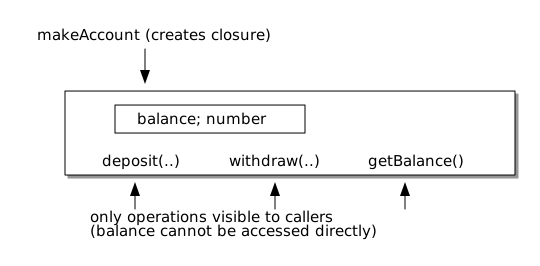
Course Preview: Does Software in Practice Enforce Security Invariants?
This chapter has been about enforcing invariants in code. The examples are small, but they have a real-world safety implication. Code runs on so many platforms and has access to so much of our data. How do we ensure that only the code we expect runs on our machines, and that it doesn't leak our information to people who shouldn't have it?
Unfortunately, a lot of real-world code doesn't manage to enforce such invariants, leading to many security and privacy issues. If the technical side interests you, look at the computer security courses (CPSC 337, CPSC 541) or cyber-security competitions (Maple Bacon Team). If the societal side does, look at CPSC 430.
Protecting Invariants Drives Design
In this chapter, the invariant drove the design at every step:
- To ensure the invariant is established, we routed the creation of every
BankAccountthrough a single constructor function. - To ensure the invariant was preserved, we bound operations to the data, so that the functions, instead of the callers, maintained the invariant.
- To ensure that no one else could violate the invariant, we hid the state within a closure.
The organisation of the code itself enforces the invariant. This is the first time we have seen an invariant shape the design of a program rather than just its documentation and tests. Protecting invariants frequently drives how code is organised, because code organised this way is safer and easier to change.
Building objects out of closures works, but the support the language gives us for this task is minimal and the code can be hard to wrap your head around. In Part 2, we will see that object-oriented programming provides direct language syntax for this pattern using constructors, methods, and fields that the language itself controls access to. The syntax will be new, but the idea is the one this chapter built by hand.
Exercise: Character Health
Practise this chapter's process on a new problem.
As a game developer, I want a character's health to stay between 0 and its maximum, so that nothing in the game can drive it out of range.
A character's health has a current hit-point count and a maximum, and must always satisfy the invariant 0 <= hp <= maxHp. A holder of a Health value should be able to apply damage, apply healing, read the current hit points, and ask whether the character is still alive, but should never be able to reach the underlying numbers directly.
- Define a
Healthtype whose properties are operations, not data:damage(amount: number): Result<Health, string>,heal(amount: number): Result<Health, string>,getHp(): number, andisAlive(): boolean. There should be nohpormaxHpfield on the type. - Write a constructor function
makeHealth(maxHp: number, hp: number): Result<Health, string>that establishes the invariant by refusing an invalid request as an erroneous outcome (reject amaxHpbelow 1, or anhpoutside0tomaxHp) and hideshpandmaxHpin a closure. Model it onmakeCounter. - Implement
damageandhealso they preserve the invariant: damage never drops hit points below 0, and heal never raises them abovemaxHp. Each should return the result of callingmakeHealthwith the new hit points, so the invariant is re-established on every change, asincrementdid for the counter. Refuse a negativeamountas an erroneous outcome, asdepositandwithdrawdo. - Add a
newCharacter(maxHp: number): Result<Health, string>helper that starts a character at full health. - Write tests. Unwrap the setup values with
assertOk, as the counter tests did. UsecheckExpectto confirm that damage and heal land on the right hit points, including that they stop at 0 and atmaxHp, and thatmakeHealthreturnsok: falsefor an invalid starting value such asmakeHealth(10, -1).